

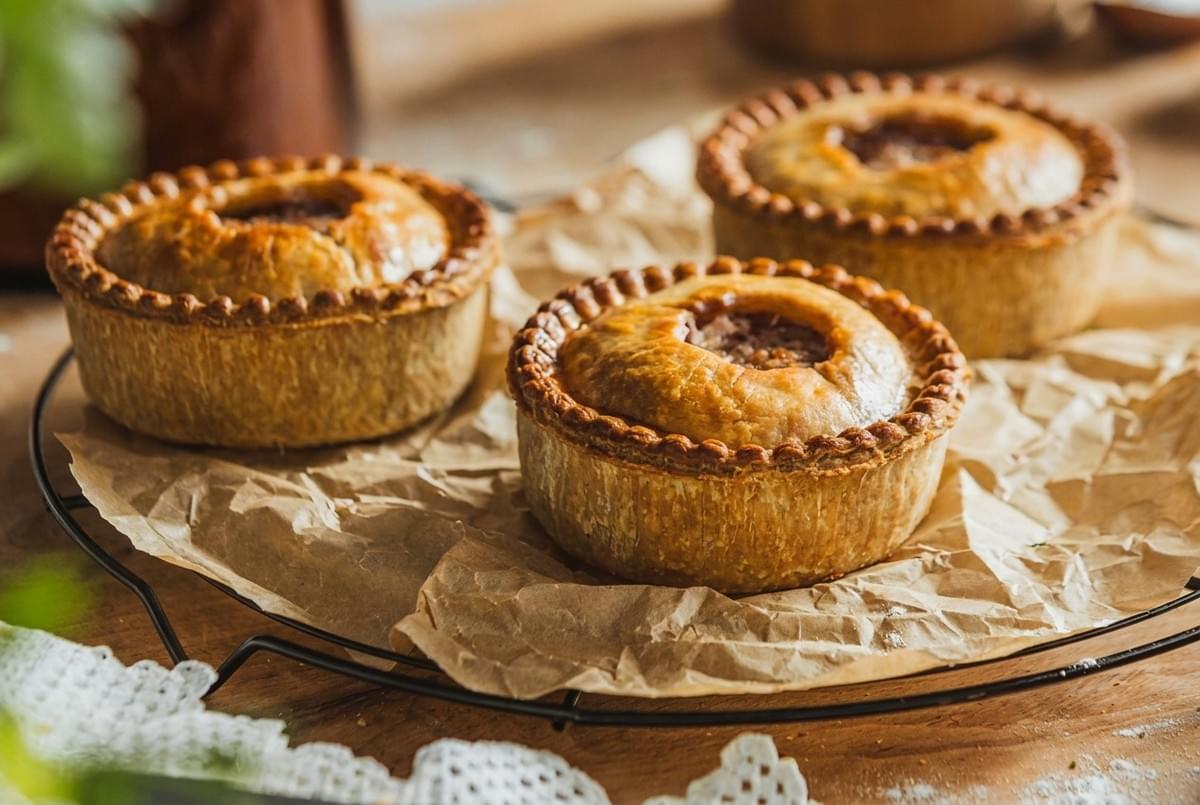
A pork pie rests on a wire rack. Its sides bow slightly outwards, and its lid has baked to a deep, glazed amber. On the hob nearby, a pudding basin sits in a pan of barely moving water, with a pleated sheet of paper tied over its rim. Someone fills the kettle. When it clicks off, they warm the pot before the tea goes in.
None of this is remarkable. That is rather the point.
Pies, puddings, and tea are ordinary food in much of Britain, and ordinary food tends to keep its history close to the surface. Look carefully at a crimped crust or a mug of strong tea with milk. You will find traces of local farming, household thrift, long-distance trade, and the shape of a working day.
These foods are not the whole story of British food traditions. Britain here means England, Scotland, and Wales, each with its own kitchens and habits, and modern British eating draws on far more than these three things. As starting points, though, they are generous ones.
Pies: Pastry, Place, and Practicality
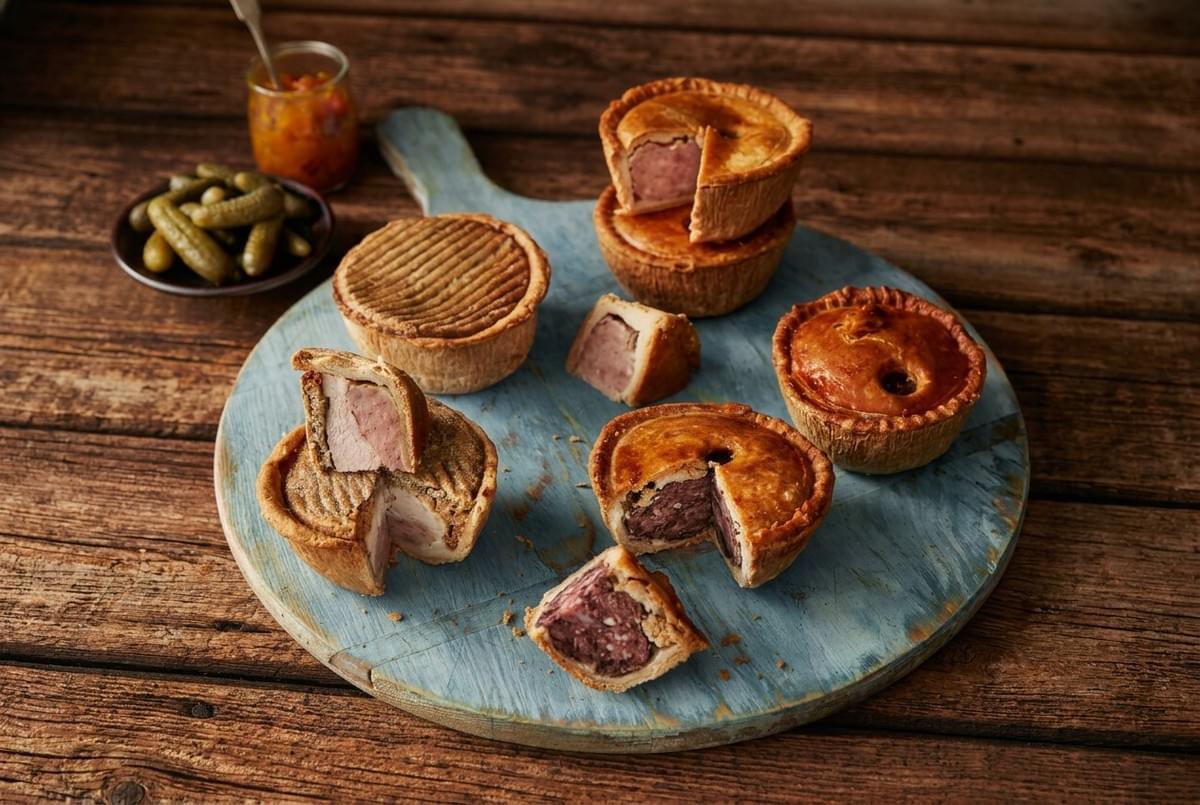
A pie answers practical questions. How do you make a modest amount of meat feed more people? How do you carry a meal to work? How do you hold a filling together long enough to cook it slowly? Pastry has offered answers for centuries, and those answers change with place.
Hot-Water Crust and Shortcrust
Two pastries do much of the work in British pies, and they behave very differently.
Shortcrust is made by rubbing cold fat into flour, then adding just enough cold water to bring the dough together. The fat coats the flour and limits gluten development, so the baked crust is tender and breaks cleanly. It suits lids, bases, and tarts where delicacy matters.
Hot-water crust works the other way round. Fat, traditionally lard, is melted in hot water and stirred into flour to form a warm, pliable dough. Cooks shape it while it is still warm, often by hand. It bakes into a firm wall that can stand without a tin. Hot-water crust is less a wrapping than a vessel.
Melton Mowbray Pork Pie
The Melton Mowbray pork pie, named after the Leicestershire market town, shows hot-water crust at its most distinctive. The pastry is hand-raised and baked free-standing, which is why its sides bow outwards. Inside is chopped, uncured pork. Because the meat is not cured, it cooks to a grey-pink colour rather than a bright pink. Once the pie cools, seasoned jellied stock fills the gap between meat and crust.
The name carries Protected Geographical Indication (PGI) status, so pies sold under it must be made within a defined area and to an agreed specification. People eat it cold and sliced, often with pickle, at picnics, buffets, and festive tables.
Steak and Ale Pie
Steak and ale pie belongs to pubs and home kitchens alike. Beef is braised in ale until the meat yields to a spoon and the liquid reduces to a dark, glossy gravy with a faint bitterness from the beer. A shortcrust or puff pastry lid usually finishes it. Cooks disagree, often cheerfully, about whether a pastry base belongs underneath.
Here, the pastry caps something cooked low and slow. It does not need to hold anything up.
The Scotch Pie
The Scotch pie is small, round, and double-crusted. It is usually made with hot-water crust and filled with minced mutton or beef, seasoned firmly with pepper. Its pastry wall rises a little above the lid, leaving a shallow well that can hold gravy, beans, or mashed potato.
Bakers and butchers sell Scotch pies across Scotland, and the pies are closely tied to football. Picture one eaten hot from a paper bag at half-time, the steam rising into cold air.
A Welsh Pie and Some Close Relatives
Wales has its own pastry traditions. Katt pie, a small mutton pie with currants and brown sugar, is associated with Templeton in Pembrokeshire and a fair held there. Its blend of meat and sweet dried fruit recalls an older style of cooking once common across Britain, before sweet and savoury settled into separate courses.
Some familiar dishes sit beside pies without quite being pies. The Cornish pasty, which also holds PGI status, is a folded, crimped pastry filled with beef, potato, swede, and onion. It belongs to a related tradition of hand-held pastry. Shepherd's pie and cottage pie skip pastry entirely and use a mashed potato topping. Shepherd's pie is traditionally made with lamb, cottage pie with beef.
Puddings: A Word with Many Meanings
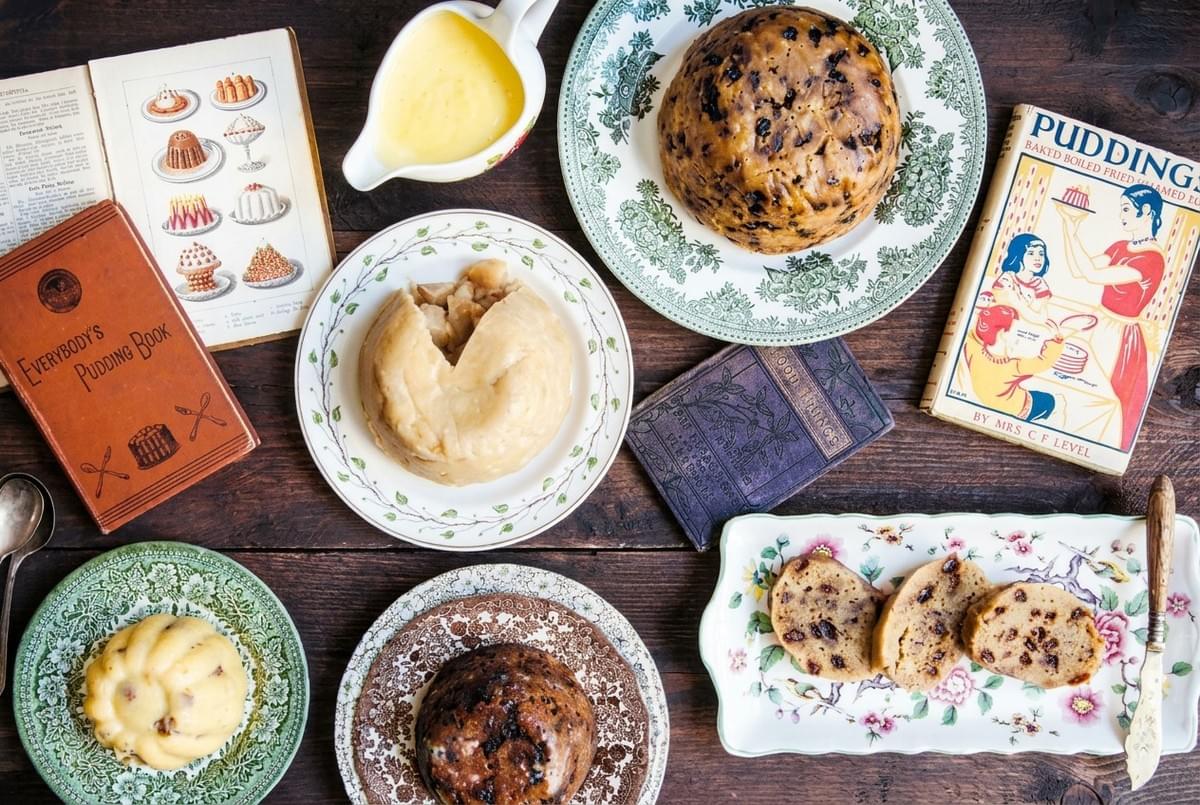
In British English, "pudding" is a slippery word. It can name a specific dish, sweet or savoury. It can also mean the dessert course itself, as in "What's for pudding?" Some households say "afters" or "sweet" instead. A pudding does not have to be sweet, and it does not have to come last.
Yorkshire Pudding
Yorkshire pudding is a batter of eggs, flour, and milk poured into very hot fat and baked until it rises, crisp at the edges and soft at the base. It once cooked beneath roasting meat to catch the dripping. Hannah Glasse's eighteenth-century cookery book is often cited as helping popularise the name.
A widely told account says it was served before the meat to take the edge off appetites in households where meat was scarce. The story is plausible and much repeated, but it is better treated as tradition than documented fact. Today it is a fixture of the Sunday roast, often holding a pool of gravy.
Steamed Suet Puddings
Suet is the firm fat from around the kidneys of cattle or sheep. Mixed into flour, it produces a dough that steams into a soft, slightly open crumb. Suet puddings can be savoury, such as steak and kidney pudding, or sweet, such as jam roly-poly and spotted dick, a suet sponge studded with dried fruit.
Puddings were once boiled in cloths. The ceramic pudding basin later became common, covered with pleated paper or cloth so the pudding has room to rise. Then it steams slowly for hours. Vegetable suet now offers a vegetarian alternative, and microwaves have shortened the process for many cooks.
Sticky Toffee Pudding
Sticky toffee pudding is a moist sponge made with chopped dates and soaked in a warm toffee sauce, often served with cream or custard. It is closely associated with the Sharrow Bay hotel in the Lake District, which helped popularise it in the 1970s, though other claims to its origin exist. It has since become a standard of pub dessert menus across Britain.
Pwdin Eva
In Wales, pwdin Eva is the Welsh name for Eve's pudding: sliced or stewed apples baked beneath a light sponge. The name nods to Eve and the apple. The appeal lies in contrast, soft fruit below and a golden, springy top that soaks up a little of the juice.
Clootie Dumpling
Scotland's clootie dumpling takes its name from the "cloot," a cloth. Flour, suet, dried fruit, spices, and often treacle are wrapped in a floured cloth and simmered for hours. When the cloth is removed, a pale skin forms on the outside. Many cooks set the dumpling briefly before a fire or in a warm oven so the skin can dry. Clootie dumpling is linked with celebrations, including birthdays and Hogmanay. Some families hide small coins or charms inside, and slices are sometimes fried the next morning.
Tea: A Drink and a Social Ritual
Of the three, tea is the most everyday and the least British in origin. Tea comes from China, and it reached Britain in the seventeenth century. Catherine of Braganza is often credited with helping make it fashionable at court after her marriage to Charles II.
For a long time, tea was expensive and heavily taxed, and smuggling was common. The East India Company traded in it, and during the nineteenth century, British-run plantations in Assam and Ceylon (now Sri Lanka) grew it under colonial rule, relying on indentured and poorly paid labour. The sugar stirred into many cups came, for generations, from Caribbean plantations worked by enslaved people. British tea culture rests on this history, even when it is not visible in the cup.
Everyday Tea
For many people, tea simply means strong black tea, brewed in a mug or pot, usually with milk. It marks work breaks, greets visitors, and follows bad news. Offering to put the kettle on is one of the most common forms of domestic hospitality in Britain.
Tea also gathers baking around it. In Wales, it might be bara brith, a fruit loaf whose name means "speckled bread," or Welsh cakes from a bakestone. In Scotland, it might be shortbread or scones.
Afternoon Tea
Afternoon tea is commonly credited to Anna, Duchess of Bedford, in the 1840s. The story goes that she took tea and something light in the late afternoon to bridge the long gap before a fashionably late dinner. The custom became a social occasion among the upper and middle classes.
Its classic form includes finger sandwiches, scones, and small cakes, often arranged on tiers. From a pastry perspective, it is a study in scale and precision. Each item is small enough for a few bites, and each must hold its shape. Today it is mostly a special-occasion meal, taken in hotels and tearooms rather than at home.
High Tea
High tea is often mistaken for a grander afternoon tea. Historically, it was nothing of the kind. It was a substantial early-evening meal in working households, eaten after the working day and served at the table. It might include meat, pies, eggs, bread, and cake, alongside a pot of tea.
That history survives in language. In much of northern England, Scotland, and Wales, "tea" can still mean the evening meal itself.
Cream Tea
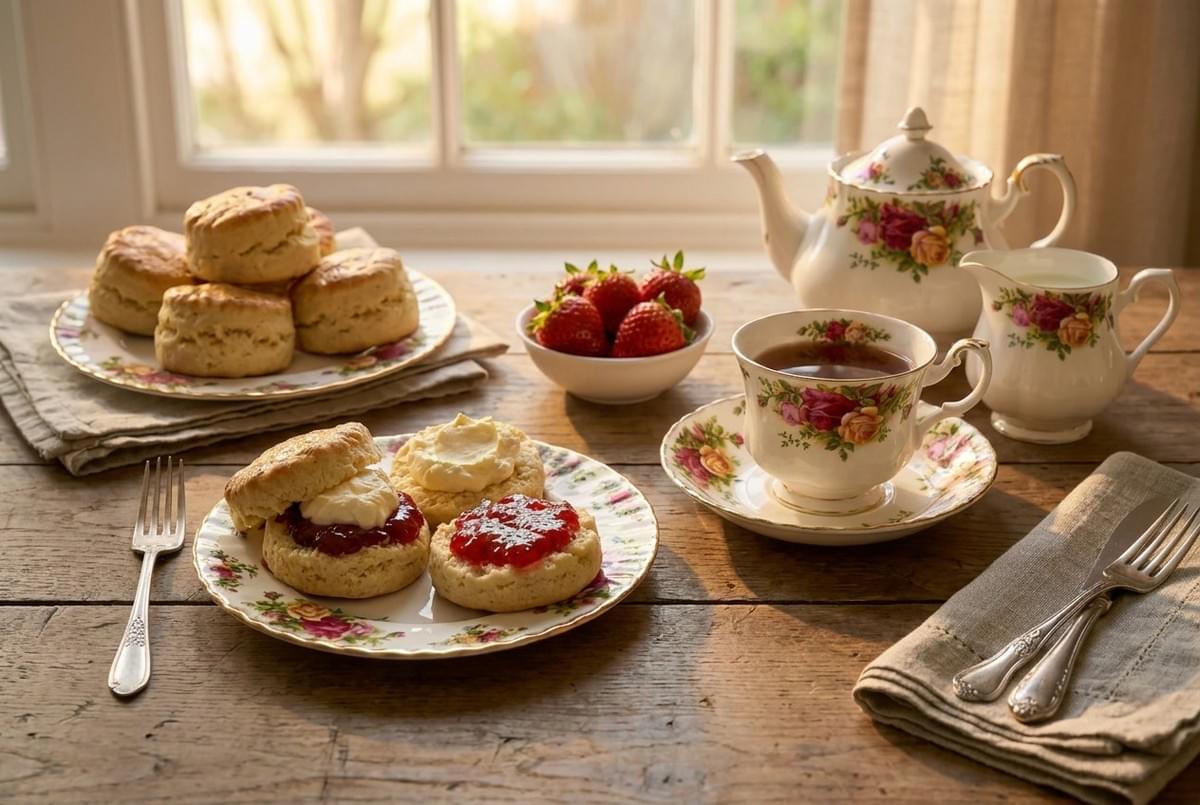
A cream tea is tea served with scones, jam, and clotted cream: thick cream made by gently heating and then cooling rich milk, leaving a golden crust. Cornish clotted cream holds Protected Designation of Origin (PDO) status.
Devon and Cornwall both claim the cream tea, and they disagree about the order of things. In Devon, cream usually goes on the scone first, with jam on top. In Cornwall, jam usually goes first, with cream spooned over it. Neither is correct for everyone, and practice varies within each county. The debate is largely good-natured, a small, sweet expression of regional pride.
Traditions That Continue to Change
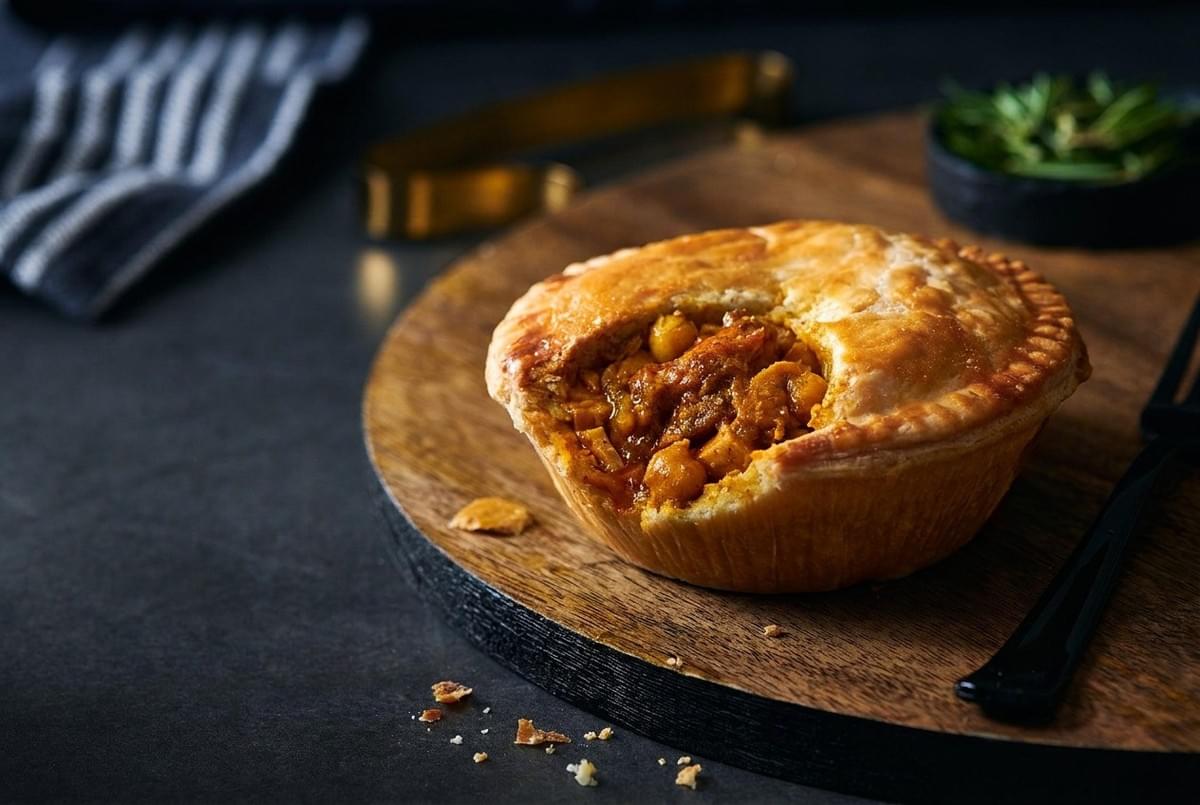
None of these foods is fixed. Independent bakeries now sell pies with long-fermented pastry and carefully sourced fillings, while high-street chains turn out sausage rolls and steak bakes by the thousand. Vegetarian and vegan pies have become common, and vegetable suet means a steamed pudding no longer needs animal fat.
Multicultural Britain has reshaped these traditions too. Curry-spiced fillings appear in pies, and the chicken balti pie has become a familiar sight at some football grounds. Cafés serve masala chai beside builder's tea. Many households drink green, herbal, or fruit teas, or none at all.
Many people rarely make pastry or steam a pudding at home now. Others keep doing so for particular days: a pie for a match, a clootie dumpling for a birthday, a Christmas pudding stirred in late November. Customs vary between nations, regions, and individual homes. There has never been a single British table, only many of them.
Crust, Steam, and a Kettle Coming to the Boil
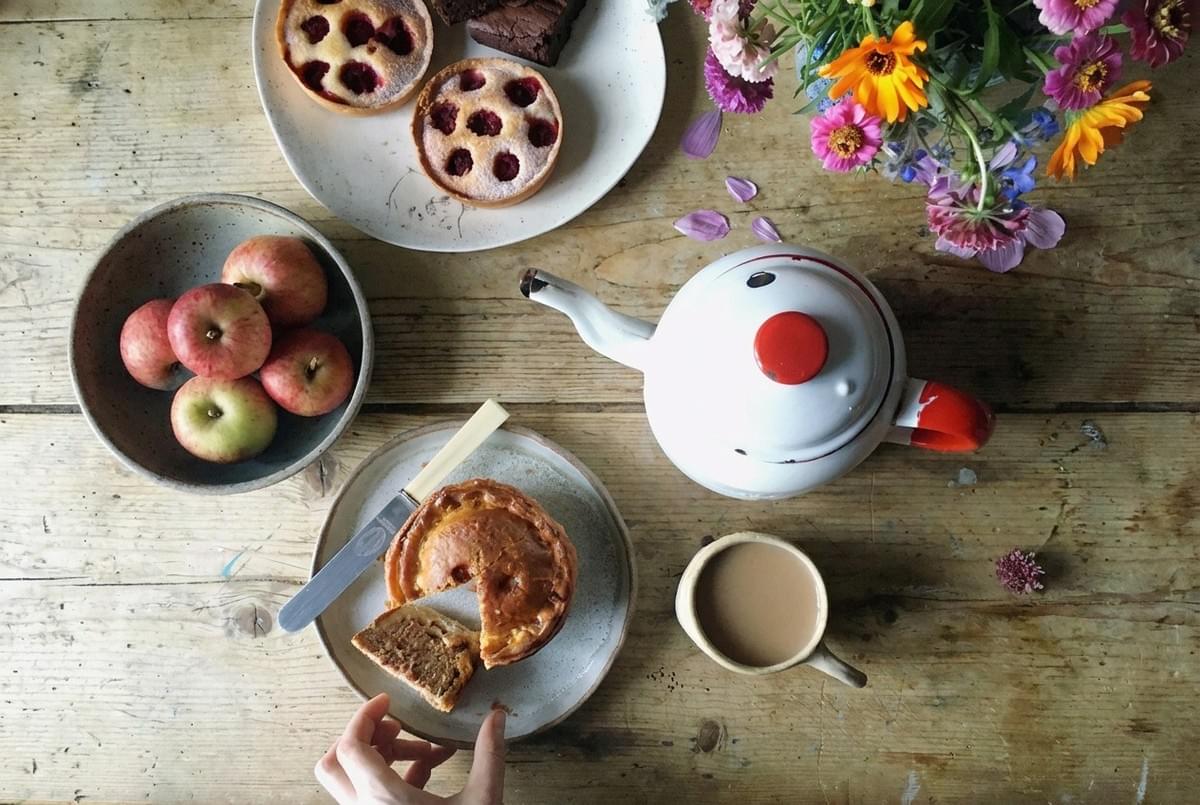
Taken together, British pies and puddings show how much depends on technique. A hot-water crust allows a pie to stand on its own. Shortcrust makes a tender lid. A cloth or basin turns flour and suet into a pudding that keeps its shape through hours of gentle steam.
They also show how place shapes food. The bowed sides of a Melton Mowbray pie, the well atop a Scotch pie, and the currants in a katt pie each carry a regional character.
Tea holds it all together. It gives people a reason to sit down, and a reason to offer something.
A pie on a rack. A basin in the steam. A pot warmed before the tea goes in. Small gestures, repeated in many kitchens over a very long time, until they become a culture.
