

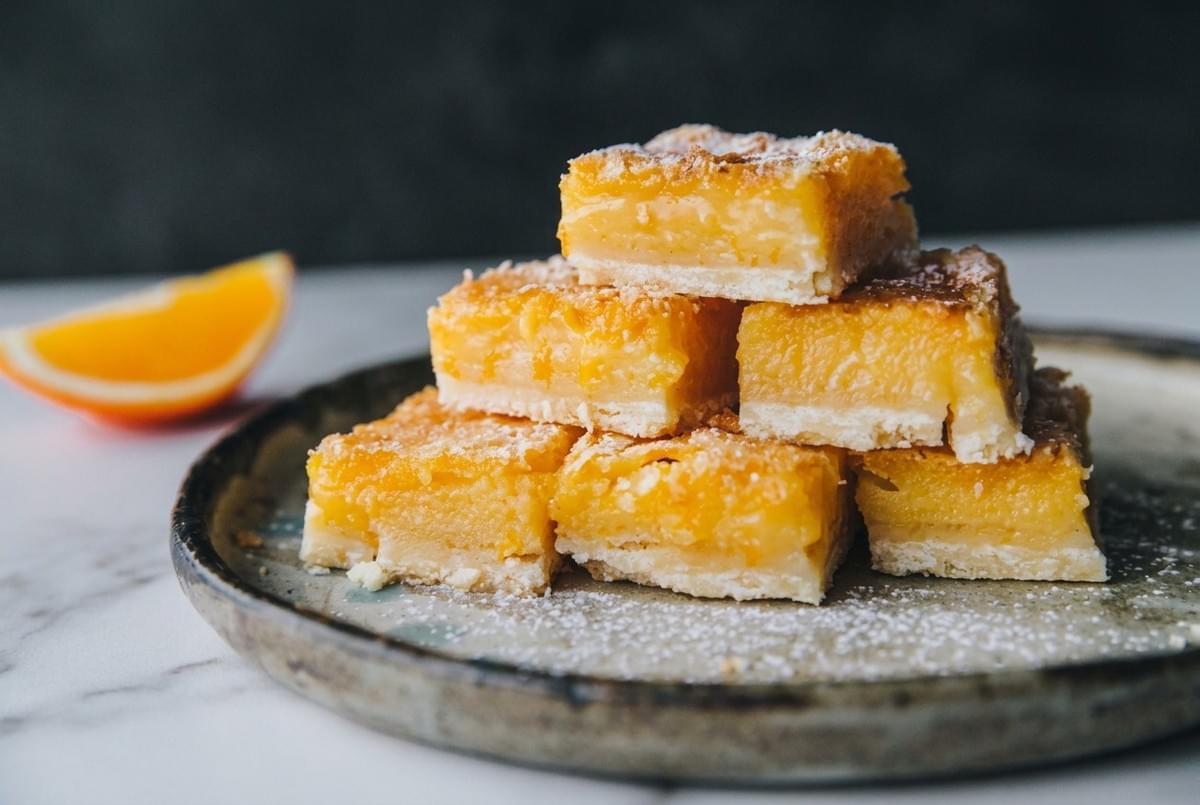
A square pan cools on the stovetop, the shortbread inside gone pale gold at the edges. The kitchen smells of butter and warm flour. Two oranges sit on the cutting board, half-bare, their peel leaving a faint oil on your fingertips.
You pour the custard slowly. It moves to the corners without being asked.
After that, there is only waiting. The oven hums. The light in the window shifts a little.
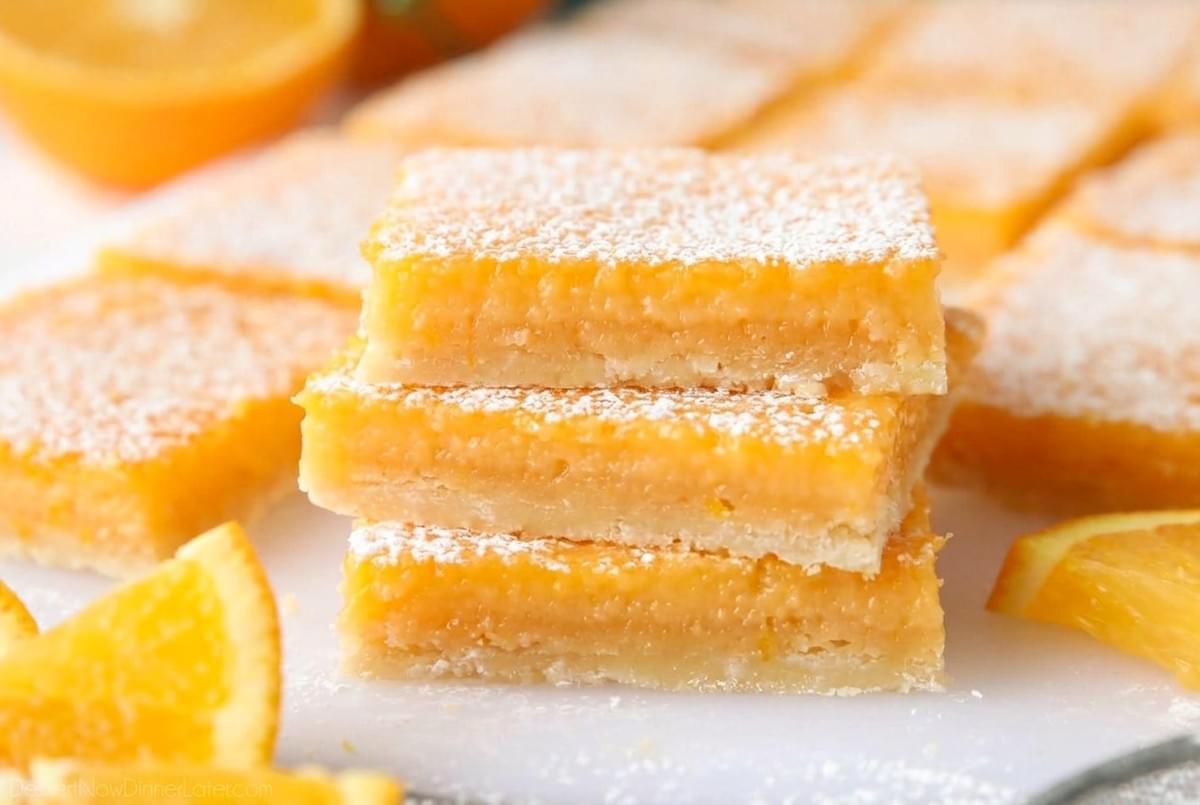
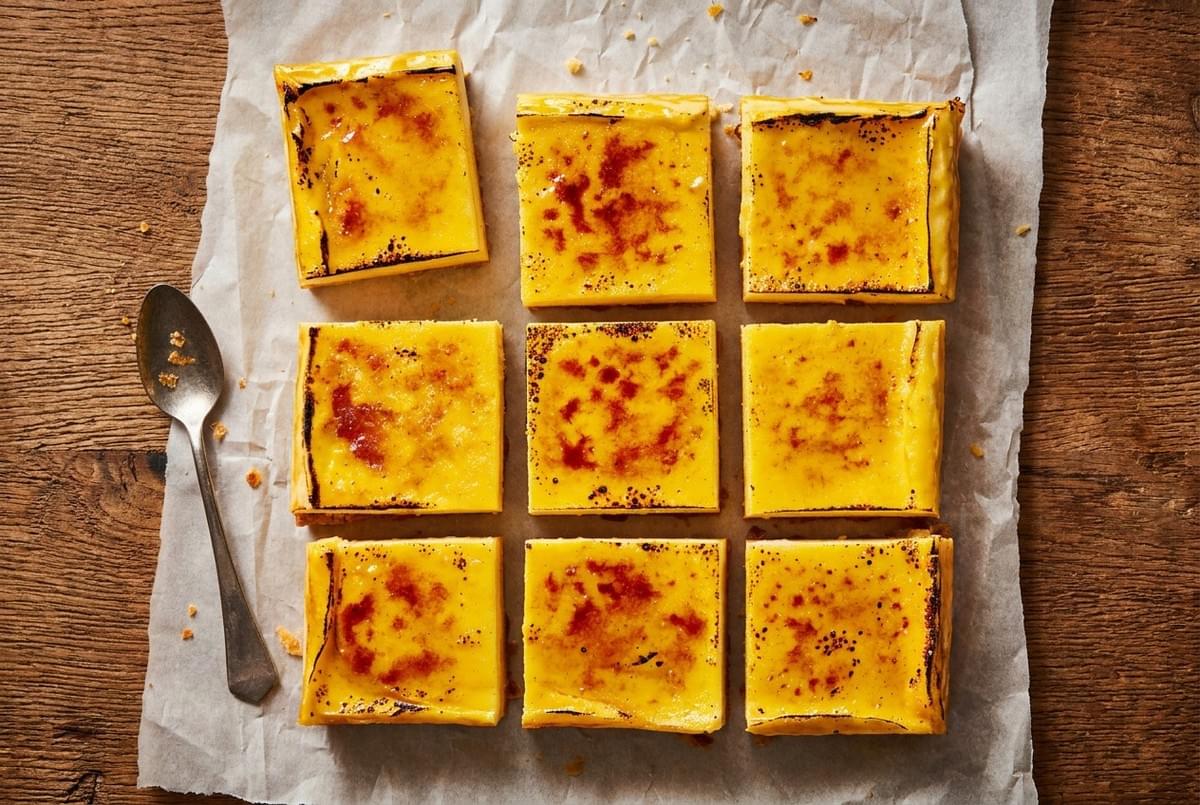
Portuguese orange custard bars are quiet things. The base is a crisp, buttery shortbread that breaks cleanly under a fork. Above it sits a layer of silky orange custard, cool and smooth, with the clean brightness of fresh zest running through the cream. A thin layer of sugar, broiled at the very end, leaves a faint caramelized top: amber in spots, slightly bitter, there and then gone.
A Note on the Bake
The idea starts with the pastel de nata, the small custard tart found in bakeries and cafés across Portugal. A good one has a crisp, flaky shell and a rich egg custard, scorched in dark patches from a very hot oven. Many people dust it with cinnamon and eat it standing at the counter, coffee close by.
Citrus has its own place in Portuguese baking. Oranges grow in parts of the country, and their zest and juice appear in home cakes and sweets, including the rolled orange cake called torta de laranja.
Orange and custard belong together for a simple reason. The acid cuts through the richness, so each bite stays bright instead of heavy. The cream, in return, softens the orange's sharper edge.
These bars are not a Portuguese pastry. They don't try to be. They're a home-kitchen bar cookie that borrows a few ideas: an egg custard, a crisp base, a scorched top, the lift of an orange. No laminated dough. No special oven. Just one square pan and an unhurried afternoon.
Recipe Overview
- Prep time: 25 minutes
- Chill time: 3 hours 15 minutes (plus 1 hour cooling at room temperature)
- Bake time: 50 to 60 minutes, including the broil
- Total time: about 5 1/2 hours, mostly hands-off
- Yield: 16 bars in an 8x8-inch (20 cm) metal pan
- Difficulty: Easy to moderate
Ingredients
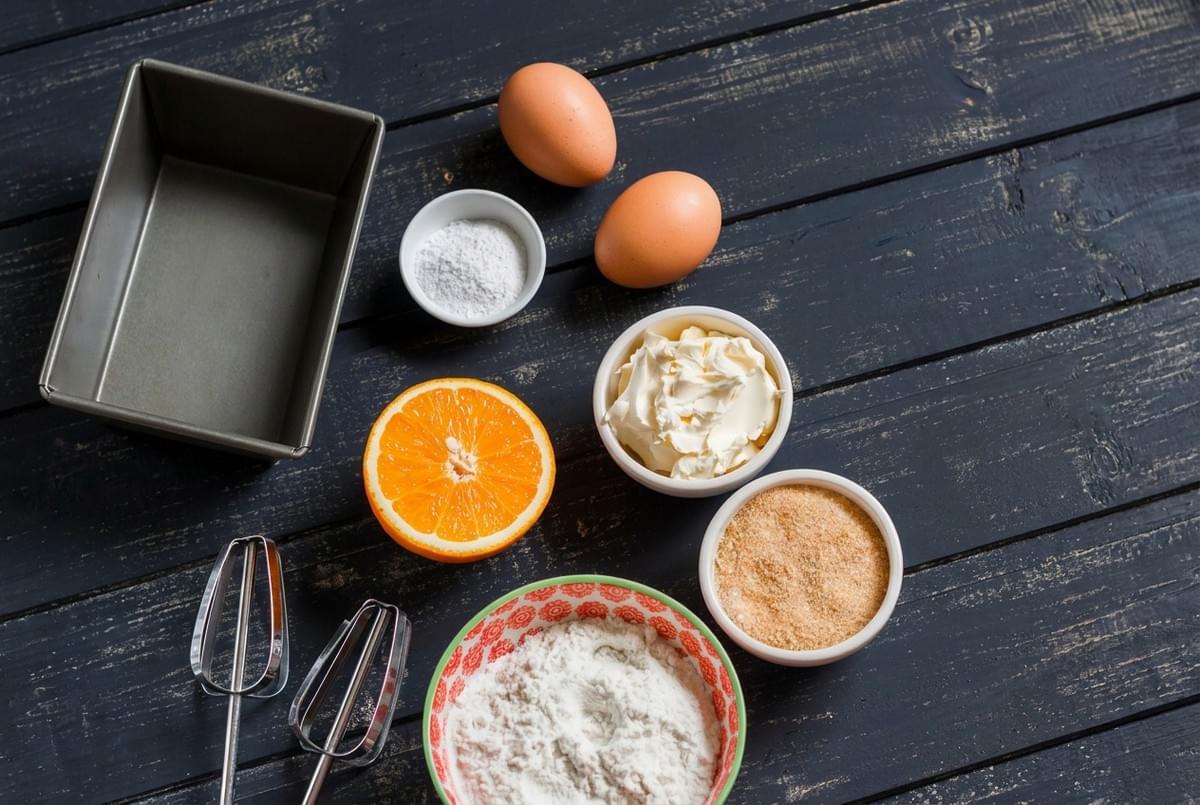
Shortbread Base
- 1 1/4 cups (156 g) all-purpose flour
- 1/3 cup (40 g) powdered sugar
- 1/4 teaspoon fine salt
- 1 teaspoon finely grated orange zest
- 1/2 cup (113 g) unsalted butter, chilled and cut into small cubes
Orange Custard Filling
- 1/2 cup (100 g) granulated sugar
- 1 tablespoon finely grated orange zest
- 1 1/2 tablespoons (12 g) cornstarch
- 2 large eggs, at room temperature
- 2 large egg yolks, at room temperature
- 1 cup (240 ml) heavy cream, at room temperature
- 1/2 cup (120 ml) whole milk, at room temperature
- 1/4 cup (60 ml) freshly squeezed orange juice
- 1/2 teaspoon vanilla extract
- Pinch of fine salt
- 1 tablespoon (12 g) granulated sugar, for the broiled top
Optional Finish
Choose one, or leave the bars plain:
- A little extra orange zest, grated over the top just before serving
- 1 to 2 teaspoons powdered sugar, dusted lightly around the edges
- A thin orange glaze: 1/2 cup (60 g) powdered sugar whisked with 2 to 3 teaspoons orange juice, drizzled in fine lines (it will hide some of the caramelized spots)
Ingredient Notes
Fresh zest carries the flavor. Most of the orange taste lives in the oils of the peel, not the juice. Extract often tastes thin or sharp, so zest real oranges and stop before the white pith, which is bitter.
Chilled butter for the base. Cold cubes rubbed into flour give a short, sandy shortbread that stays crisp under the custard. Softened or melted butter makes a denser base.
Whole eggs plus yolks. The whole eggs give the custard enough structure to slice cleanly. The extra yolks add richness and a close, silky texture.
A little cornstarch. It steadies the custard when the orange juice meets the cream. It also helps the bars hold sharp edges when you cut them.
How to Make Portuguese Orange Custard Bars
The Base
- Heat the oven and line the pan. Heat the oven to 350°F (175°C) with a rack in the center. Line an 8x8-inch (20 cm) metal pan with parchment, leaving a short overhang on two sides for lifting. Use metal, not glass, because the bars finish under the broiler.
- Rub in the butter. Whisk the flour, powdered sugar, salt, and 1 teaspoon zest in a bowl. Add the chilled butter and rub it in with your fingertips until the mixture holds together when squeezed and no dry flour remains. The warmth of your hands softens the butter just enough to bind the crumbs.
- Press and chill. Tip the crumbs into the pan and press them into an even layer with the bottom of a measuring cup, working into the corners. Chill for 15 minutes. Cold butter helps the base keep its shape in the oven.
- Bake the base. Bake for 20 to 22 minutes, until the edges are golden and the center looks dry and pale gold. Lower the oven to 325°F (165°C) and leave the base in the pan.
[IMAGE: overhead of the baked shortbread base in the parchment-lined pan, golden at the edges, a half-zested orange and a microplane beside it]
The Custard
- Rub the zest into the sugar. While the base bakes, rub the 1/2 cup sugar and 1 tablespoon zest together in a large bowl for about 30 seconds. The sugar should look damp and smell strongly of orange. Whisk in the cornstarch.
- Whisk in the eggs. Add the eggs and yolks and whisk gently until smooth and pale yellow, about 1 minute. Go slowly, since foam on top bakes into bubbles.
- Add the liquids. Whisk in the cream, milk, vanilla, and salt. Pour in the orange juice last, whisking steadily as it goes in. Strain the custard through a fine-mesh sieve into a large measuring cup.
- Pour over the warm base. Pull out the oven rack, set the pan on it, and pour the custard slowly over the base. Pop any surface bubbles with a toothpick.
Bake, Broil, and Chill
- Bake the custard. Bake at 325°F (165°C) for 28 to 34 minutes. It's ready when the custard is set at the edges with a slight wobble in the center, like set gelatin. If the middle ripples like liquid, give it 3 to 5 minutes more.
- Broil the sugar top. Move a rack about 6 inches below the broiler and set it to high. Sprinkle the 1 tablespoon sugar evenly over the custard, and fold the parchment overhang down against the pan, away from the element. Broil for 1 to 3 minutes, watching the whole time, and pull the pan the moment amber spots appear.
- Cool slowly. Set the pan on a wire rack and let it cool to room temperature, about 1 hour. A gentle cool helps keep the custard from cracking.
- Chill and slice. Refrigerate, uncovered, for at least 3 hours, until cold and firm. Lift the slab out by the parchment and cut into 16 squares, about 2 inches each.
[IMAGE: overhead of the chilled slab in the pan, custard set and smooth, top freckled with amber from the broiler]
Baking Tips and Doneness Cues
- Trust the wobble, not the timer. The center should still jiggle a little when the pan comes out. It finishes setting as it cools, and a firm center in the oven often turns rubbery later.
- Keep the heat low and steady. Custard curdles when eggs heat too fast. Room-temperature ingredients, a 325°F (165°C) oven, and the cornstarch all keep it smooth.
- Give it the full chill. Warm custard smears under a knife. Three hours in the fridge is what makes clean slices possible.
- Use a hot knife. Dip a long knife in hot water, wipe it dry, and press straight down in one motion. Wipe and reheat the blade before each new cut.
- Trim the edges if you like. For sharp squares, cut a thin strip from each side first. Those scraps tend to disappear before the plate is set down.
[IMAGE: a warm knife lifting one clean-cut bar from the slab, the layers straight and distinct, a glass of hot water nearby]
Variations and Substitutions
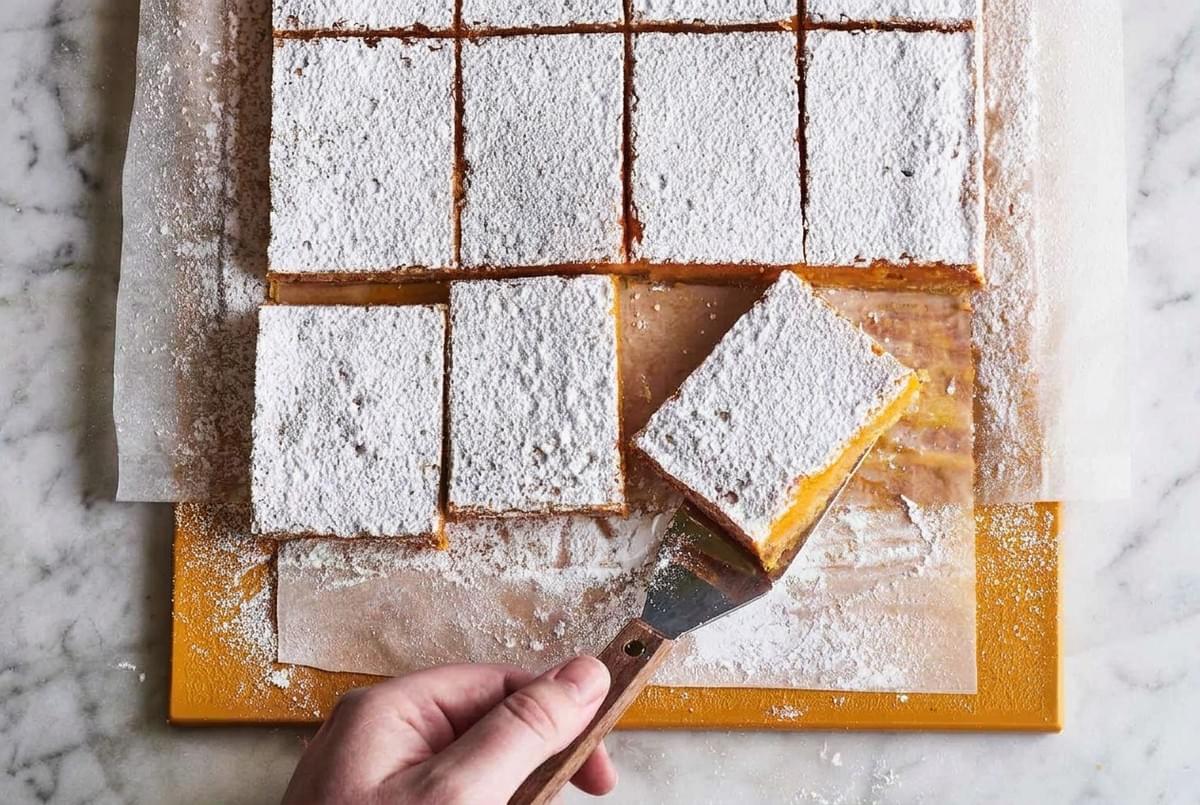
- Lemon or blood orange: Use the same amount of zest and juice. Lemon is sharper, so add 1 extra tablespoon (12 g) sugar to the custard. Blood orange tastes softer, almost berry-like.
- A touch of spice: Whisk 1/4 teaspoon ground cinnamon or cardamom into the custard sugar. Or dust the chilled bars with cinnamon, the way many people finish a pastel de nata.
- Gluten-free base: Swap in a 1:1 gluten-free baking flour blend. The base turns a little more crumbly, so press it firmly.
- Torched top: Skip the broiler. Just before serving, sprinkle the chilled slab with 1 tablespoon sugar and melt it with a kitchen torch until amber. The crackle softens in the fridge, so torch only what you plan to serve.
- Small tartlets: Press about 1 1/2 tablespoons of base into each cup of a lined 12-cup muffin tin. Bake at 350°F (175°C) for 12 to 15 minutes, fill, then bake at 325°F (165°C) for 15 to 20 minutes, until the centers barely wobble. Timing will vary with your tin.
Storage and Make-Ahead
Fridge: Keep the bars in an airtight container for up to 4 days, with parchment between layers. The base softens a little each day. The broiled top loses its crackle after day 1 but keeps its color.
Freezer: Freeze plain bars, without glaze or powdered sugar, in a single layer until firm. Wrap them tightly and freeze for up to 1 month. Thaw overnight in the fridge. The custard may be slightly softer afterward.
Make-ahead: Bake the bars the day before you need them. They often cut more cleanly on day 2. Add zest, powdered sugar, or glaze just before serving.
Frequently Asked Questions
Why did my custard crack?
Usually it baked a little too long, or the oven runs hot. Take the bars out while the center still wobbles, and let them cool on the counter before they go in the fridge.
Can I freeze these bars?
Yes, for up to 1 month. Freeze them plain and thaw them overnight in the fridge. The texture shifts slightly, but they still slice well.
Does bottled orange juice work?
It does, though fresh juice tastes brighter. Bottled juice can taste flat or cooked. You'll still need fresh oranges for the zest, which carries most of the flavor.
Why is my custard grainy?
Small grains usually mean the eggs cooked too quickly. Bring your ingredients to room temperature, strain the custard before pouring, and keep the oven at 325°F (165°C).
After the Oven Clicks Off
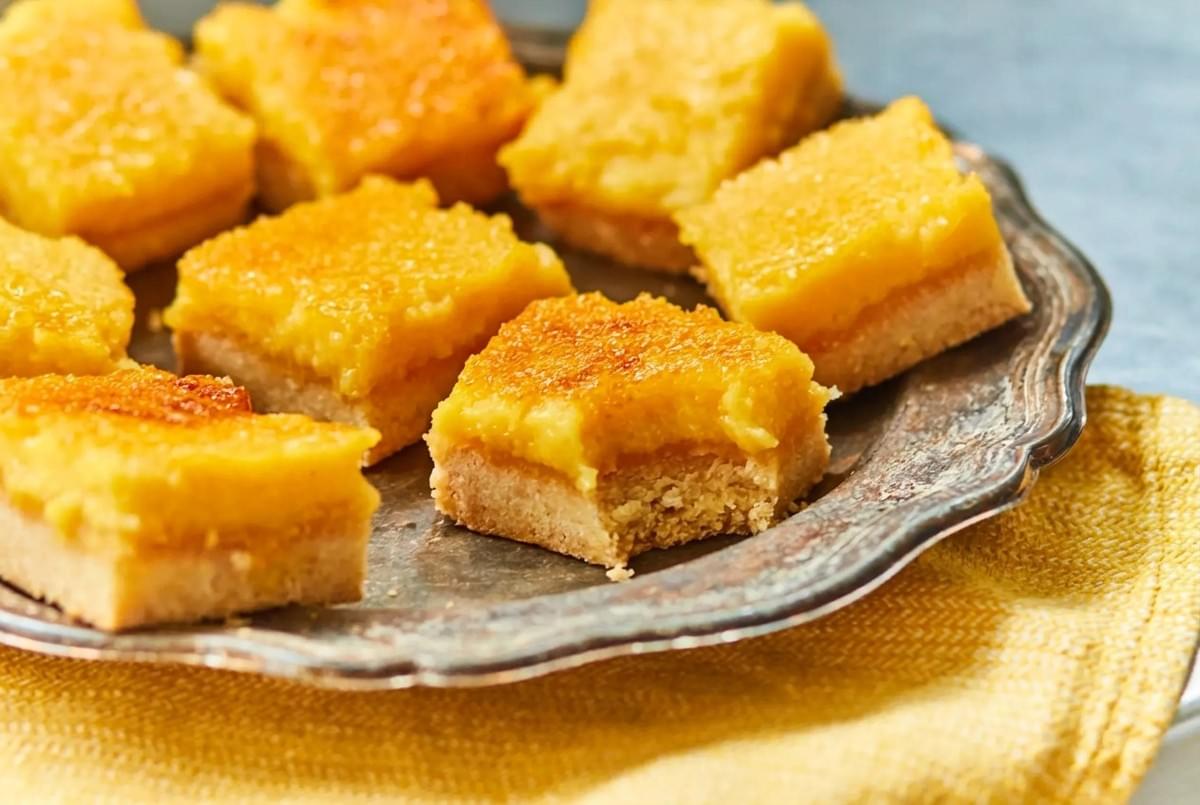
The pan sits cold in the fridge now. The kitchen still smells faintly of orange peel.
Later, you'll lift out a square and set it on a small plate. Butter, cream, a little scorched sugar. Nothing else needed.
If you bake these, tell us which oranges you used, and whether one square was enough.
